AA, Alcoholism and Boarding School
Oct 12, 2026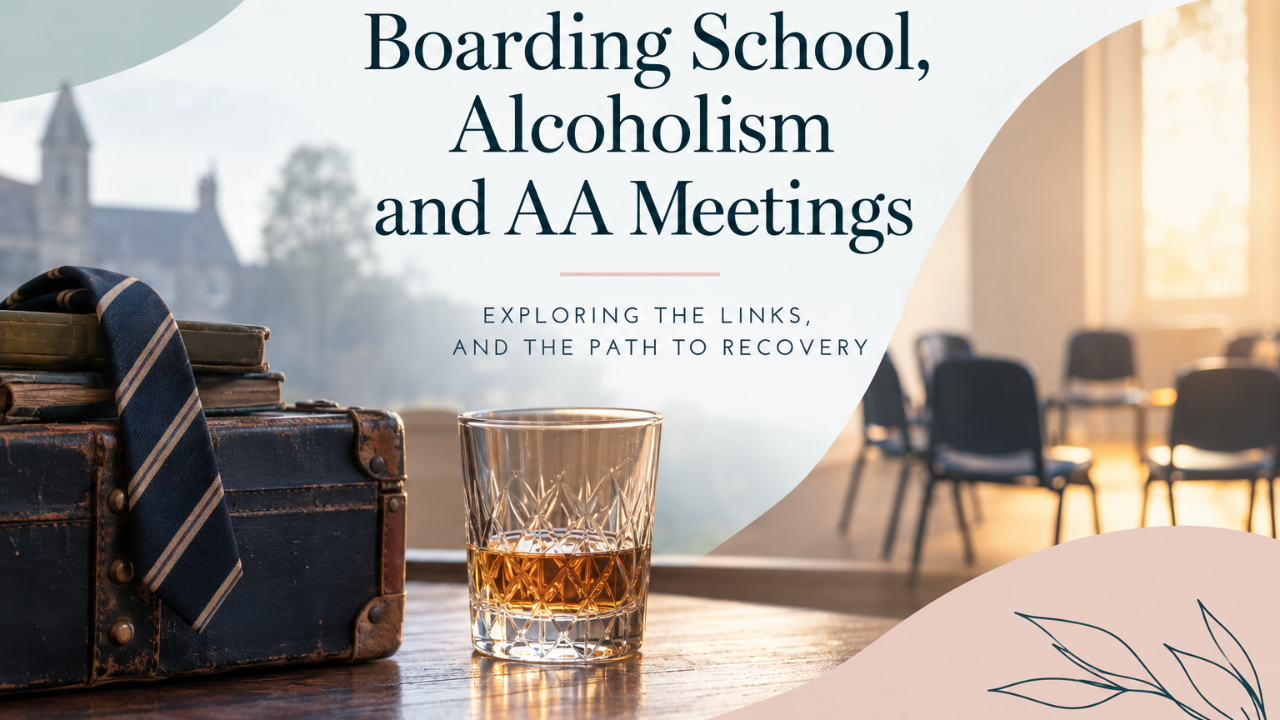
Below is an article written by a former boarder containing her observations about Alcoholism, Boarding School and AA meetings.
Well over ten years ago, I walked down a cobbled street into a small chapel in the hope that it would separate me from my dependency on alcohol.
It was, if you hadn’t guessed, a meeting of Alcoholics Anonymous. Three months later, after a little blip, I began my journey of recovery using the Twelve Step programme and a good sponsor to guide me. I still regularly attend meetings, and without wishing to sound too twee, it really was the best decision I have ever made.
Fast forward five years, and a woman I’d recently met asked me to teach her the Twelve Steps. In exploring her life story, she revealed that she had been sent to Boarding School.
“I don’t really remember much,” she told me.
“Me neither!” I said.
We both accepted that being sent away was “for the best” and any difficulties we may have had were just a result of us being ungrateful or awkward with life. We both presumed that it was fine for most children, but we were just maladaptive and that’s why neither of us really enjoyed it or maximised its opportunities! For the most part, we both acknowledged our childhoods were a big morass of nothingness where memories were concerned.
How wrong we were!
We just learnt never to think about it, nor to talk about it. We’d just moved on from it - or so we believed.
A year later, I was holidaying far from where I ordinarily lived so I popped into an unfamiliar AA meeting. Through sheer happenstance, it transpired that almost all of the attendees there had also been to Boarding School. On returning to my regular women’s meeting, I mentioned this unusual, and very random, discovery when it was my turn to ‘share’. Immediately, half of the women spontaneously raised their hands in what became a very profound, “me too!” moment. Since then, I have come to notice that ex-boarders make up a huge proportion of regular AA meeting-goers!
Yet a quick google informs anyone interested that fewer than 1% of English children are sent to Boarding School. This begs the question: why are we so over-represented in drug & alcohol rehab centres, AA or other mental-health support systems such as Change Grow Live (CGL) or Smart Recovery?*
A lot of sobriety-based literature assumes that alcoholism runs in families - yet my sponsee was the only drunk in hers, and although my mother had been very fond of the booze herself, there wasn’t to my knowledge, a lot of drinking in my wider family. In fact, barely any!
I was brought up in an institution - that meant suppressing my feelings, my wants and my needs in order to conform to the strictures of that way of life. I never grew up organically, I simply had to watch what others did and copy it. There was no loving guidance, no empathy, no positive adult role models upon whom to emulate. Just rules and bells, and bells and rules.
Subsequently, I found adulting hard - especially relating to people and being at ease in groups. I finally discovered the medicinal benefits of alcohol in my early twenties. It gave me respite on a Friday night when I’d shut the door on a world I didn’t really understand nor feel a part of. It helped me relax. It helped me sleep. It helped me feel okay in my own skin. It was so good - I took more of it. I married a heavy drinker, a man older than me, and learnt it was okay to drink mid-week too. Eventually, over the decades, it ran out of control and without much fanfare, I realised I simply couldn’t stop even if I wanted to.
There was no big rock bottom, no sudden cataclysmic event. It just dawned on me I was committing the slowest form of suicide available. I was sick and tired of always feeling sick and tired. I was also acutely depressed, anxious and overwhelmed by the events of my life (divorce, loss of home…I could go on). Alcohol no longer helped me numb out, and life had just become a repetitive cycle of thinking about drinking, drinking or recovering from my last drink.
I chose AA because it asked nothing of me. No one demanded I fill in any forms, or talk about myself. It didn’t ask for a monthly subscription, nor sign up to any course of action I was uncomfortable with. All I ever heard was, “Keep coming back.” and subsequently I have never left. Through it I have built a busy social life and sense of self. The Fellowship has helped me grow up as well as grow through tough times. In too many ways to count, the principles underpinning the Twelve Steps have provided the parental guidance that I was deprived of in my childhood.
I was six years sober when I realised that I was not born alcoholic - that in all probability being sent away had made me one. There really is no other way of explaining why so many ex-boarders have had drink and drug problems, especially in our early twenties. Some grow out of it, but others, like me, find our consumption progresses over time. The sad fact is finding long-term sobriety is not a given - the vast majority of people who abuse alcohol will have their lives acutely damaged by it. It also adversely impacts the lives of those who love us. As they say in AA: it is the only disease that tells you you don’t have it.
Boarding Schools are swift to take credit for our successes, and yet, up and down the country, far too many ex-boarders are either dying from excessive alcohol consumption, or trying to get help to stop. Therapy has, naturally, beckoned in various points of my life - and sometimes it was worthwhile. It did have one stark realisation though: not one counsellor had ever asked me about Boarding School. It is seen universally as a privilege and if none of the professionals seem to know how or what to ask in order to get us talking, then I suspect the true benefits of therapy aren’t so readily accessible to the ex-boarder.
Seeing one who had not only specialised in the psychology of the ex-boarder, but also been to one herself, has played an instrumental role in helping me along my own recovery journey.
In recent years, I have become a part of the ever-growing community of ex-boarders speaking up and out about the dark side of boarding school - which is why I think it is high time we talk about the prevalence of alcohol-use disorders and the ex-boarder.
It is not my fault I am alcoholic, but it is my responsibility to stay sober and help others to achieve sobriety. I am no longer ashamed of my drinking past, but instead I am rather proud that I have overcome it. Ex-boarders are taught to be independent and not ask for help.
You can be a rebel and ask for help.
More information on Alcoholics Anonymous can be found here
https://www.alcoholics-anonymous.org.uk/
*CGL and Smart Recovery are the government-supported drug and alcohol schemes available in southern England, but there are plenty of others too. Access to these services is usually obtained via your GP, but many do take direct enquiries too.